
If a factory failed a social compliance audit, it should first review and prioritize the findings, contain any immediate risks, root cause analysis, and develop a Corrective Action Plan (CAP). Each corrective action should have a responsible owner, deadline, supporting evidence, and effectiveness check. The factory should then implement the improvements, verify that they work in practice, communicate progress with the customer, and prepare for follow-up verification or re-audit. The goal is not simply to close findings, but to correct the management-system weaknesses that caused them.
A Failed Social Compliance Audit Is Not the End. It Is the Start of Remediation
Failing a social compliance audit can be a serious concern for a manufacturer, especially when the factory supplies global brands.
However, an audit failure does not always mean the customer relationship ends immediately.
What matters next is how the factory responds to the findings.
A strong response demonstrates that management understands the problem, takes responsibility for corrective action, and has a structured system for preventing the same issue from happening again.
The Fair Labor Association (FLA), for example, includes both immediate actions and sustainable improvement recommendations based on root cause analysis within its factory assessment approach.
So what should a factory do next?
1. Review and Understand Every Audit Finding
The first step after a failed social compliance audit is to understand exactly what the auditor found and which requirement was not met.
Do not immediately start correcting issues without understanding the finding.
For each finding, ask:
- What requirement was violated?
- What evidence did the auditor identify?
- Is the issue isolated or systemic?
- Which workers or departments are affected?
- Is there an immediate worker safety or labor-rights risk?
- Does the issue involve a third party such as a recruitment agency?
- What customer requirement applies?
Depending on the customer’s audit program, findings may also have different levels of severity or urgency.
The factory should therefore prioritize the most serious issues first.
2. Take Immediate Action on Critical Risks
Some findings cannot wait for a long-term improvement project.
If the audit identifies an immediate health, safety, or worker-rights risk, the factory should first contain the problem.
For example:
Finding: An emergency exit is blocked.
Immediate correction: Remove the obstruction.
Or:
Finding: Workers are operating machinery without required protective equipment.
Immediate correction: Stop unsafe work and provide appropriate PPE.
These actions protect workers immediately.
However, they do not necessarily solve the underlying problem.
That requires the next step.
3. Conduct Root Cause Analysis
One of the biggest mistakes after failing an audit is to correct only what the auditor saw.
For example: Finding: Emergency exit blocked.
Removing the boxes solves the visible problem.
But why were they stored there?
Possible root causes could include:
- Insufficient storage space
- No assigned responsibility
- Missing inspection procedures
- Poor employee training
- Weak supervision
- Production pressure
- No internal compliance monitoring
Without identifying the root cause, the same finding may return during the next audit.
A useful corrective-action structure is: Finding → Root Cause → Corrective Action → Verification
The FLA’s assessment framework similarly emphasizes sustainable improvements based on root cause analysis, rather than only immediate corrections.
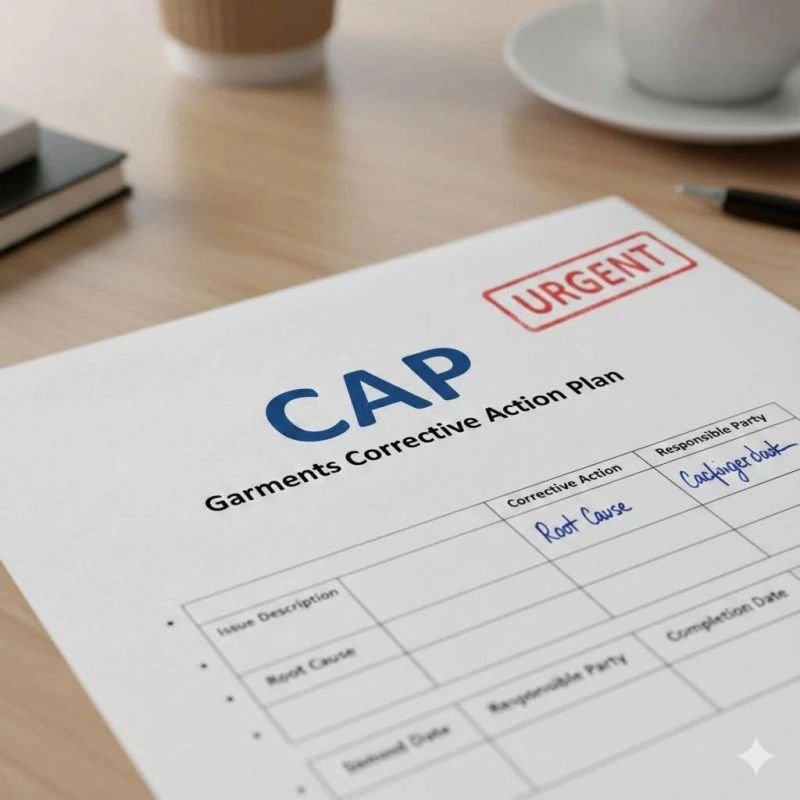
4. Develop a Corrective Action Plan (CAP)
Once the root causes are understood, the factory should create a Corrective Action Plan (CAP).
A good CAP should clearly answer:
| CAP Element | Key Question |
|---|---|
| Finding | What did the auditor identify? |
| Requirement | Which requirement was not met? |
| Root Cause | Why did the problem occur? |
| Immediate Correction | What was done immediately? |
| Corrective Action | What will prevent recurrence? |
| Responsible Owner | Who will implement it? |
| Deadline | When will it be completed? |
| Evidence | How will completion be demonstrated? |
| Effectiveness Check | How will we know it works? |
FLA remediation cases also demonstrate the use of specific corrective action steps tied to findings and subsequent monitoring of implementation.
5. Assign Clear Responsibility and Deadlines
A corrective action without an owner often remains unfinished.
Each CAP item should have: One responsible department or person + one deadline + measurable evidence.
Depending on the finding, responsibility may involve:
- HR
- EHS
- Production
- Facility management
- Senior management
- Compliance
- Procurement
- Labor agency management
For example:
Finding: Migrant workers do not understand the grievance procedure.
Weak action: HR will provide training.
Better action: HR will translate the grievance procedure into workers’ primary languages, conduct training for all migrant workers by September 30, maintain attendance records, and verify understanding through confidential worker interviews.
The second action is easier to manage, measure, and verify.
6. Address Third-Party and Labor Agency Risks
Some social compliance findings originate outside the factory.
This is particularly important when manufacturers use external agencies to recruit migrant workers.
Potential issues may include:
- Recruitment fees
- Contract discrepancies
- Worker debt
- Payroll deductions
- Document retention
- Recruitment information
- Accommodation
- Worker communication
- Grievance access
A factory should not simply respond: “The labor agency handles this.”
Instead, manufacturers should review how the agency operates and whether its practices meet customer requirements.
A stronger remediation approach may include: Agency review → Contract review → Worker interviews → Recruitment practice verification → Corrective action → Periodic monitoring
Recruitment may be outsourced, but compliance responsibility cannot simply be outsourced with it.
7. Implement the Corrective Actions
Writing the CAP is not enough. The factory must demonstrate that corrective actions have actually been implemented.
Implementation may include:
- Revising policies
- Updating procedures
- Training workers and managers
- Improving payroll controls
- Changing working-hour management
- Improving safety controls
- Translating worker communications
- Updating employment contracts
- Strengthening grievance mechanisms
- Reviewing recruitment practices
- Requiring corrective action from labor agencies
- Introducing internal inspections
The goal is to change the actual system, not simply produce more documentation.
8. Collect Objective Evidence
Customers and auditors may require evidence showing that corrective actions were completed.
Evidence may include:
- Updated procedures
- Training records
- Attendance records
- Payroll records
- Photos
- Inspection reports
- Worker interview results
- Revised contracts
- Agency agreements
- Corrective action records
- Internal audit reports
Evidence should demonstrate both:
What was changed and Whether the change was implemented.
A newly written policy alone may not be sufficient if workers do not understand or follow it.
9. Verify Corrective Action Effectiveness
This is one of the most important steps and one factories sometimes overlook.
The factory should ask: Did our corrective action actually solve the problem?
For example:
Finding: Workers did not know how to use the grievance mechanism.
The factory:
- Updated the grievance procedure
- Translated it
- Conducted training
- Posted information around the factory
Everything appears completed.
But an effectiveness check should go one step further: Interview workers confidentially two weeks later.
If workers still cannot explain how to report a grievance, the corrective action has not yet been effective.
FLA remediation examples likewise show that implementation may be monitored and independently verified before remediation is considered complete.
10. Communicate Progress With the Customer
Factories should maintain clear communication with the customer throughout remediation.
Rather than waiting until every finding is closed, provide structured updates showing:
- Finding status
- Root cause
- Corrective action
- Responsible owner
- Target completion date
- Evidence
- Verification status
Transparent communication demonstrates that the factory is actively managing the problem. Trying to hide, minimize, or quickly close findings without adequate evidence can create greater customer concern.
11. Conduct an Internal Verification Before the Re-Audit
Before requesting or undergoing a customer re-audit, conduct an internal verification. Do not simply review documents. Repeat parts of the audit process.
Document Review
Check:
- Payroll
- Attendance
- Working hours
- Employment contracts
- Recruitment records
- Training
- Corrective action evidence
Factory Walk-Through
Verify actual:
- PPE usage
- Emergency exits
- Safety conditions
- Chemical storage
- Workplace conditions
Worker Interviews
Ask whether employees understand:
- Working conditions
- Wages
- Safety procedures
- Grievance channels
- Employment terms
Agency Review
If migrant workers are involved, verify that corrective actions have also reached relevant recruitment agencies.
The objective is to identify remaining gaps before the customer does.
12. Prepare for Follow-Up Verification or Re-Audit
Once corrective actions have been implemented and internally verified, the customer may conduct:
- Document verification
- Remote follow-up
- On-site follow-up
- Worker interviews
- A partial re-audit
- A full social compliance re-audit
The exact process depends on the customer’s compliance program and the severity of the original findings.
A successful re-audit should demonstrate not only that the original problem disappeared, but that the factory now has stronger controls to prevent recurrence.
From Audit Finding to Sustainable Improvement
The remediation process can be summarized as:
Audit Finding → Immediate Correction → Root Cause Analysis → Corrective Action Plan → Assign Owner & Deadline → Implementation → Objective Evidence → Effectiveness Verification → Internal Review → Customer Follow-Up / Re-Audit
This is the difference between simply trying to pass the next audit and actually improving the factory’s management system.
What Should Factories Avoid After Failing an Audit?
Factories should avoid several common mistakes:
- Fixing only what is visible
- Changing records without fixing actual practices
- Blaming workers or recruitment agencies without investigating root causes
- Creating policies that employees do not understand
- Submitting CAPs with vague actions
- Closing findings without effectiveness verification
- Waiting until the re-audit to check implementation
- Treating social compliance as only an HR responsibility
Social compliance often involves multiple functions across the organization.
Management involvement is therefore essential.
Final Thoughts
A failed social compliance audit should be treated as a management-system improvement opportunity, not simply a checklist of problems to close.
The strongest factories do more than respond to individual findings. They investigate why those findings occurred, strengthen internal controls, verify corrective actions, and monitor whether improvements remain effective over time.
For manufacturers supplying global brands, a structured remediation process can help protect workers, reduce supply-chain risk, improve customer confidence, and prepare the factory for future assessments.
At SCM Solution, we support manufacturers and international customers with factory assessments, root cause analysis, Corrective Action Plans, implementation follow-up, supplier management, and on-the-ground verification.
The goal is not simply to close the audit finding. It is to prevent the finding from happening again.
FAQ
A factory should review the findings, prioritize urgent risks, take immediate corrective action where necessary, and begin root cause analysis. The next step is to develop a structured Corrective Action Plan with owners, deadlines, evidence requirements, and effectiveness checks.
If a factory fails a social compliance audit, the customer may require corrective actions, supporting evidence, follow-up verification, or a re-audit. The exact consequences depend on the severity of the findings and the customer’s supplier compliance program.
Not necessarily. A failed social compliance audit does not automatically mean the supplier relationship will end. Customers may allow remediation when the factory demonstrates commitment, implements corrective actions, and resolves findings within required timelines.
However, serious or unresolved violations may create greater business risk.
A Corrective Action Plan (CAP) documents how a factory will resolve audit findings and prevent recurrence. It should include the finding, root cause, immediate correction, corrective action, responsible owner, deadline, supporting evidence, and effectiveness verification.
A factory should prioritize findings according to worker risk, legal requirements, customer severity classifications, and urgency. Immediate safety or serious worker-rights risks generally require faster action than lower-risk documentation or administrative gaps.
A correction fixes the immediate problem, while corrective action addresses the cause of the problem to prevent recurrence. For example, removing boxes from an emergency exit is a correction. Improving storage controls, inspections, training, and responsibility assignment is corrective action.
Root cause analysis asks why the finding occurred rather than only what happened. Factories can review processes, interview employees, examine records, analyze management responsibilities, and use techniques such as the 5 Whys to identify underlying system weaknesses.
Evidence may include revised procedures, training records, payroll or attendance records, photographs, worker interview results, employment contracts, inspection reports, agency agreements, and internal audit records. Evidence should demonstrate that the corrective action was implemented, not simply planned.
Factories should perform an effectiveness check after implementation. This may involve reviewing new records, inspecting the workplace, interviewing workers, repeating internal audits, or monitoring performance over a defined period. A finding should not be considered fully resolved simply because an action was completed.
Possibly. Customers may require follow-up verification or a re-audit depending on the original findings and their compliance program. Verification may involve document review, remote evidence review, an on-site visit, worker interviews, or another full assessment.
There is no universal corrective-action deadline for every social compliance audit. Deadlines depend on the customer, audit standard, severity of the finding, and type of corrective action required. Factories should follow the timelines stated in the audit report or agreed CAP.
A factory may be able to clarify or challenge a finding if it has objective evidence showing that the auditor’s conclusion was inaccurate or incomplete, depending on the audit program. The response should be evidence-based rather than simply disagreeing with the auditor.
Responsibility should be assigned to the department or manager who controls the underlying process. Corrective actions may involve HR, EHS, production, compliance, procurement, senior management, facility management, or external labor agencies. Social compliance should not automatically be treated as an HR-only responsibility.
The factory should investigate both its own controls and the agency’s practices. This may include reviewing contracts, recruitment fees, employment terms, worker interviews, document handling, payroll deductions, accommodation, and grievance mechanisms. Using a third-party agency does not automatically transfer compliance responsibility away from the factory.
The factory should review the entire migrant worker recruitment and employment process, including recruitment fees, contracts, agency practices, document management, wages, deductions, accommodation, communication, safety training, and grievance access. Confidential worker interviews are particularly useful for identifying gaps that may not appear in documentation.
Correcting the visible problem is only the first step. The factory should still determine why the problem occurred and implement controls that prevent recurrence. Without root cause analysis, the same finding may return during the next audit.
Yes. Submitting a Corrective Action Plan does not guarantee that a factory will pass the re-audit. Auditors may verify whether corrective actions were actually implemented and whether they work effectively in practice. Documentation alone may therefore be insufficient.
Before a re-audit, the factory should verify every CAP item, review supporting evidence, conduct a factory walk-through, check payroll and employment records, interview workers, and confirm that corrective actions remain effective. An internal pre-audit can help identify remaining gaps before the customer returns.
Yes. Unresolved or serious social compliance findings can affect supplier approval, future orders, sourcing decisions, or the customer’s willingness to continue the relationship. The impact depends on the customer’s supplier standards and severity of the issues. This is why timely and transparent remediation is important.
Factories can reduce future audit failures by treating social compliance as an ongoing management system. This includes regular internal assessments, worker communication, management training, agency oversight, record verification, safety monitoring, grievance systems, root cause analysis, and continuous corrective action. Audit readiness should be the result of normal factory management, not last-minute preparation.
Read other related articles:
Follow our LinkedIn page to get further activities
Subscribe to Yvette’s LinkedIn newsletter to read more other case studies in supply chain
