
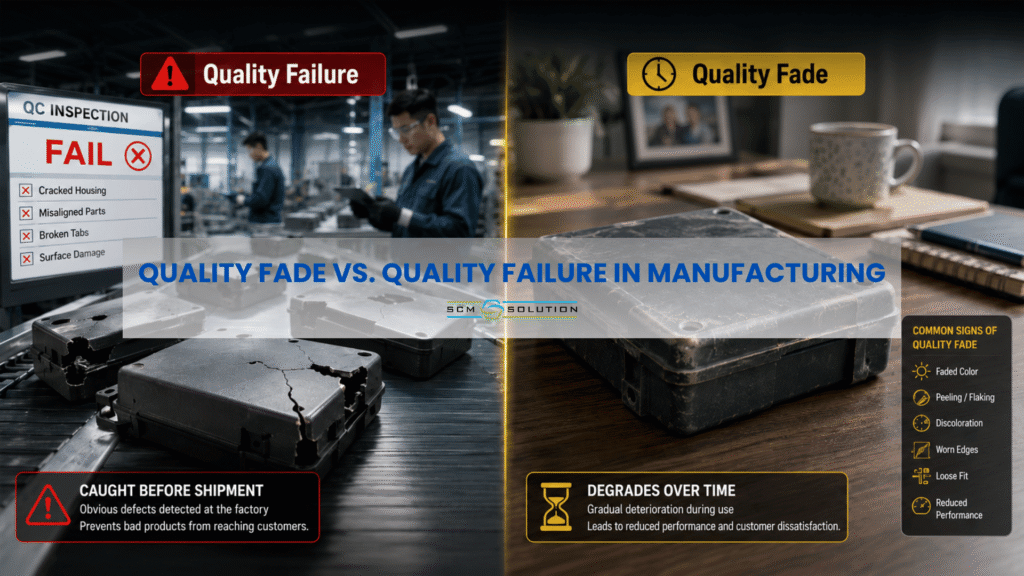
Quality fade and quality failure are two distinct problems in manufacturing. Quality fade is a slow, gradual decline in product standards across multiple production runs, often deliberate, driven by a supplier cutting costs incrementally after securing your business. Quality failure is a sudden, identifiable defect in a single production run usually accidental, caused by a process error or material fault. Quality fade is harder to detect because no single shipment looks clearly wrong. Quality failure is easier to catch with standard inspection. Both damage your brand, but quality fade is more dangerous long-term because it goes unnoticed for months.
The difference between Quality Fade and Quality Failure: Two Problems That Look Similar but Demand Different Solutions
If you source products from overseas manufacturers, you’ve probably encountered both scenarios: a shipment that arrives with obvious defects, and a product line that quietly gets worse over time without any single moment you can point to.
These are not the same problem. They don’t have the same cause, they don’t follow the same pattern, and they don’t respond to the same solution.
Confusing quality fade with quality failure or treating them interchangeably is one of the most expensive mistakes importers and product brands make in supplier management. Getting a failed shipment replaced is a process. Reversing years of undetected quality erosion can cost you your brand.
This article draws a clear, practical line between the two and shows you exactly how to manage each one.
What Is Quality Failure?
Quality failure is a specific, identifiable departure from agreed specifications in a defined production run. It has a clear cause, a clear moment of occurrence, and a clear scope — typically one batch or shipment.
Examples of quality failure:
- A batch of electronics where 15% of units have a faulty capacitor
- A clothing order where the wrong colorway dye was used
- A food product shipment that tests positive for contamination
- A toy order where parts are 3mm larger than spec, failing safety compliance
- Packaging printed with the wrong barcode
Quality failure is what most people think of when they hear “supplier problem.” It is dramatic, detectable, and once found relatively straightforward to address.
What Is Quality Fade?
Quality fade is the incremental, cumulative degradation of product quality across multiple production runs over weeks, months, or years. It rarely has a single identifiable cause moment. Instead, it is the accumulated result of many small changes, any one of which might pass inspection individually.
Examples of quality fade:
- A garment’s fabric weight quietly drops from 240gsm to 195gsm over 18 months
- A plastic housing wall thickness decreases from 2.8mm to 2.1mm over four production cycles
- A food supplement’s active ingredient concentration gradually drops below label claims
- The stitching thread count in a bag slowly decreases until seams fail after light use
- Electronic components are progressively substituted with cheaper, lower-spec equivalents
Quality fade is insidious precisely because it is designed or allowed to be invisible. The product still looks right. It still passes a casual inspection. But it is no longer what you ordered, and it no longer delivers what your customer expects.
Quality Fade vs. Quality Failure: Side-by-Side Comparison
| Dimension | Quality Failure | Quality Fade |
| Speed of onset | Sudden in one production run | Gradual across months or years |
| Visibility | Usually obvious on inspection | Subtle; requires trend comparison |
| Cause | Process error, material defect, human mistake | Cost-cutting, complacency, supplier pressure |
| Intent | Almost always accidental | Sometimes deliberate; often opportunistic |
| Scope | One batch or shipment | Entire product line over time |
| Detection method | Standard AQL inspection | Supplier scorecard + trend analysis |
| Customer impact | Immediate complaints, returns | Gradual trust erosion, rising return rate |
| Brand risk | Short-term, manageable | Long-term, potentially permanent |
| Resolution | Corrective action on one run | Systemic supplier relationship change |
| Legal liability | Product liability, recalls | Harder to prove; warranty, reputation |
| Warning signs | Failed inspection, customer complaints | Defect rate trend, feel/weight changes |
How Each One Starts: The Origin Story
- How Quality Failure Starts
Quality failure almost always originates from a specific, traceable event:
- Process breakdown: A machine goes out of calibration. A temperature setting is wrong during a production run. A new operator makes a mistake.
- Material substitution accident: A raw material supplier delivers a non-conforming batch. The factory uses it without detecting the issue.
- Communication failure: Specifications are misunderstood. A design change isn’t communicated clearly to the production floor.
- Capacity overload: The factory is at peak capacity and rushes a run. QC steps are skipped under time pressure.
In most quality failure cases, the factory knows something went wrong or discovers it quickly. The question becomes whether they disclose it to you.
- How Quality Fade Starts
Quality fade has a more gradual, often calculated origin:
- Margin pressure: Your supplier agreed to a price they struggle to maintain as raw material costs rise. Rather than renegotiate, they begin quietly substituting cheaper inputs.
- Complacency: You’ve worked with this supplier for three years without issues. Inspection frequency drops. The supplier notices and standards gradually relax.
- Staff and process change: Key quality personnel leave the factory. A new production manager optimizes for speed and cost. Standards drift without anyone making a single dramatic decision.
- Subcontracting creep: Peak demand leads the factory to subcontract work to a cheaper facility. Output quality is slightly lower. No one tells you.
- Competitive pricing response: You’ve pushed price down hard over several negotiating cycles. The supplier, unwilling to lose your business but unable to maintain margins, takes the savings from somewhere else.
In most quality fade scenarios, there is no single moment of failure. There is only a direction and the direction is down.
How Each One Is Detected
Detecting Quality Failure
The challenge with quality failure is not detection, it’s response speed and supplier accountability. Quality failure is detectable through standard quality control processes:
- Pre-shipment inspection (PSI): An inspector samples the finished goods against your specifications. Clear defects, wrong dimensions, faulty function, wrong color are caught.
- Incoming quality control (IQC): Your warehouse or fulfillment center detects problems when goods arrive.
- Customer complaints: Even if inspection fails, a batch-wide failure generates a rapid spike in customer complaints, recognizable because it’s sudden and concentrated in one batch or order date range.
- Lab testing: For regulated products, third-party lab testing catches specification failures that visual inspection might miss.
Detecting Quality Fade
Quality fade cannot be detected by any single inspection. By definition, each shipment may pass your AQL threshold individually. Detection requires:
- Trend analysis: Tracking defect rates, complaint rates, and lab test results across multiple production runs. A rate that is slowly rising is the signature signal of quality fade.
- Approved sample comparison: Regularly comparing current production against a sealed, co-signed original approved sample. Differences that are invisible run-to-run become obvious against the original baseline.
- Market surveillance testing: Buying your own product from retail channels and submitting it to independent lab testing comparing results against original specification sign-off data.
- Weight and dimension tracking: For physical products, logging unit weight and key dimensions across runs. These numbers should not drift. Any consistent directional movement is a red flag.
- Customer return pattern analysis: A gradual increase in return rate particularly when return reasons shift from “changed mind” to “product quality” is often the first market signal of quality fade in progress.
How Each One Damages Your Business
The Business Impact of Quality Failure
Quality failure creates acute, concentrated damage:
- Immediate financial cost: Rework, return logistics, replacement shipments
- Inventory write-offs: A failed batch may be unsalable
- Customer refunds and chargebacks: Direct P&L impact
- Regulatory exposure: For safety-critical or regulated products, a quality failure can trigger mandatory recalls, regulatory fines, and legal liability
- Relationship damage: A major quality failure can end a supplier relationship, requiring you to rebuild your supply chain
The damage is painful, but it is bounded. You know the scope, it’s one production run. You can quantify it. You can address it with a corrective action plan. You can communicate clearly with your customers about it.
The Business Impact of Quality Fade
Quality fade creates chronic, compounding damage:
- Brand erosion: Customers who loved your product two years ago find it “not as good as it used to be.” They don’t return. They don’t complain to you, they just leave.
- Rising return and complaint rates: The signal is there, but it builds slowly. By the time the pattern is undeniable, significant damage is done.
- Regulatory drift: For products with safety or content regulations, gradual specification drift can move you into non-compliance without a single dramatic event.
- Supplier relationship cost: Discovering and confronting quality fade after years of undetected decline is a much harder conversation than addressing a single quality failure.
- Reputational damage that’s hard to reverse: Unlike a quality failure where a swift, transparent response can actually strengthen customer trust, quality fade’s damage is diffuse and long-term. Customers don’t connect their disappointment to a specific batch. They just lose faith in the brand.
The most dangerous thing about quality fade is that your business feels fine while it’s happening. Revenue doesn’t drop suddenly. Complaints don’t spike. It’s only when you look back over 12–18 months of data or when you put current production next to your original approved sample that the full picture becomes visible.
How to Respond to Each One
Responding to Quality Failure
- Step 1 — Contain: Immediately quarantine the affected batch. Do not ship to customers.
- Step 2 — Quantify: Conduct a full inspection or lab test to determine the scope and severity of the failure.
- Step 3 — Communicate: Notify your supplier formally, in writing, with documented evidence. Reference the contract terms for non-conforming goods.
- Step 4 — Remediate: Negotiate rework, replacement, or refund depending on severity, timeline, and contract terms.
- Step 5 — Root cause analysis: Require a written Corrective Action / Preventive Action (CAPA) report from the supplier detailing what caused the failure and what has been changed to prevent recurrence.
- Step 6 — Follow-up inspection: The next production run should be inspected with heightened scrutiny and the CAPA measures should be verifiable on the production floor.
Responding to Quality Fade
- Step 1 — Document the trend: Pull together your inspection reports, defect rate data, and any customer complaint data. Build the trend picture in writing before approaching the supplier.
- Step 2 — Benchmark against approved sample: Physically compare current production against the original approved sample, or conduct lab tests comparing current and original specifications.
- Step 3 — Formal supplier meeting: Present the trend data to your supplier in a formal business review. Frame it as data, not accusation. Ask for their explanation.
- Step 4 — Corrective action with measurement: Agree on specific, measurable targets materials must return to original specifications, defect rate must return to baseline with a defined timeline and verification process.
- Step 5 — Re-inspect every run: Until the trend reverses and stabilizes, inspect every production run. Do not return to reduced inspection frequency.
- Step 6 — Evaluate the relationship: If the corrective action plan is not followed, or if the supplier is unable to explain how quality fade occurred, this is a serious relationship signal. Begin qualifying alternative suppliers.
The Overlap Zone: When Quality Fade Leads to Quality Failure
These two problems are not always separate. Quality fade that is left unchecked will eventually cross a threshold and become quality failure.
A plastic housing that has been wall-thinned over 12 production runs will eventually thin enough to crack under normal use. A food supplement whose active ingredient has been gradually diluted will eventually fall below the legal minimum. A garment whose fabric weight has been steadily reduced will eventually fail durability testing.
This is the ultimate cost of undetected quality fade: it doesn’t stay subtle forever. It eventually becomes a crisis, a recall, a regulatory action, a wave of customer complaints at which point the accumulated damage is far greater than if the fade had been caught and corrected in its early stages.
Building a System That Catches Both
The good news: the systems that detect quality failure and quality fade are complementary. A robust quality management framework catches both.
For quality failure:
- Pre-shipment inspection with AQL sampling on every shipment
- Clear contractual specifications on every PO
- Lab testing for regulated or safety-critical products
- Incoming QC at your warehouse
- Supplier CAPA process for every significant failure
For quality fade:
- Supplier scorecard tracking defect rates, pass/fail rates, and complaint data across runs
- Approved sample comparison during inspection, not just specification sheets
- Market surveillance testing 1–2 times per year
- Physical attribute tracking (weight, dimensions) across production runs
- Annual or semi-annual factory audits
- Multi-supplier strategy to maintain competitive pressure
FAQ
Quality failure is a sudden, specific defect in a single production run, usually accidental and detectable through standard inspection. Quality fade is a gradual, cumulative decline in product quality across multiple production runs, often intentional or opportunistic, and only detectable through trend analysis over time. Quality failure is an event; quality fade is a direction.
Quality fade is generally more dangerous to a business in the long term. Quality failure is acute and visible, it can be addressed quickly and, if handled transparently, may not permanently damage customer trust. Quality fade is chronic and invisible by the time it’s detected, the brand may have already lost customers who simply stopped buying without ever filing a complaint. The cumulative damage to brand equity from undetected quality fade typically exceeds the cost of any single quality failure event.
Yes. Quality fade that is left unaddressed will eventually cross a threshold and become quality failure. A product that is gradually degraded, thinner walls, lower-grade materials, reduced active ingredient concentration will eventually degrade far enough to cause visible defects, safety failures, or regulatory non-compliance. This is why early detection of quality fade is critical: it prevents a gradual problem from escalating into a crisis.
Not always. Quality failure can result from buyer-side issues as well: unclear or incomplete specifications, unrealistic pricing that puts the supplier under pressure, design changes that are communicated late, or insufficient testing of original samples. However, once specifications are clearly agreed upon and documented in the purchase order, the responsibility for conformance lies with the supplier.
Detecting quality fade requires systematic trend tracking across multiple production runs. Key methods include: maintaining a supplier scorecard that logs defect rates per run; physically comparing current production against original approved samples; conducting independent lab tests periodically; tracking physical attributes like unit weight and key dimensions across runs; and analyzing customer return rates for gradual upward trends. No single inspection will reveal quality fade, only a pattern of data over time makes it visible.
Yes, and relatively quickly. A quality failure typically generates a concentrated cluster of negative reviews linked to a specific purchase date range, customers who received goods from the affected batch report the same defect pattern. This makes it easier to diagnose than quality fade, where reviews show a gradual decline in satisfaction scores over many months without a clear batch correlation.
CAPA stands for Corrective Action / Preventive Action. A CAPA report is a formal document submitted by a supplier after a quality failure, detailing: the root cause of the failure, the immediate corrective action taken, and the systemic preventive actions implemented to ensure the failure does not recur. CAPA is the standard industry response to quality failures. For quality fade, a similar but broader remediation plan is required, addressing specification drift, material substitutions, and process changes across multiple production runs.
Yes. Not all quality fade is deliberate. Staff turnover at factories can mean that the experienced workers who maintained original quality standards are replaced by less-trained workers who unknowingly allow standards to drift. Process changes new machinery, new material suppliers, changed production sequences, can introduce quality drift without malicious intent. However, even unintentional quality fade is still the supplier’s responsibility to detect, disclose, and correct.
When buyers negotiate prices below a sustainable margin, suppliers face a choice: lose the business or find savings somewhere. For some suppliers, the “savings” come from raw material substitution, reduced labor quality, or process shortcuts. The buyer who drives the hardest bargain may unknowingly be creating the conditions for quality fade. Sustainable pricing combined with clear contractual specifications is one of the less-discussed but genuinely effective tools for preventing quality fade.
Effective contract clauses for both issues include: (1) detailed product specifications incorporated by reference into every PO; (2) AQL levels stated as contract terms; (3) inspection rights including unannounced visits; (4) penalty clauses tied to defect rates above agreed thresholds; (5) the right to reject and return non-conforming goods at supplier cost; (6) prohibition on unauthorized material substitution; (7) disclosure requirements for subcontracting; and (8) a minimum frequency requirement for approved sample comparison during production QC.
Quality fade is extremely common in global sourcing, particularly in long-term supplier relationships where buyer oversight is low. Industry reporting from sourcing professionals consistently shows that the majority of experienced importers have encountered quality fade at some point in their supply chain. It is most prevalent in low-cost manufacturing countries, in commodity product categories, and in relationships where the buyer has not implemented systematic quality tracking across production runs.
An approved sample is a physical product sample, co-signed and sealed by both buyer and supplier that serves as the quality benchmark for all future production. It is important for both issues: for quality failure, it gives inspectors an unambiguous reference point to detect deviations in a single run; for quality fade, it provides a fixed baseline to compare against current production across multiple runs, making incremental drift visible that would otherwise be invisible run-to-run.
Yes. A quality failure response is typically urgent and specific: “Batch #X has a 12% defect rate on dimension Y, we are quarantining the shipment and require a CAPA within 5 business days.” A quality fade response is evidence-based and trend-focused: “Our data shows defect rates have increased from 1.1% to 4.3% over the last six production runs. Lab testing shows fabric weight has decreased from 240gsm to 195gsm versus our approved sample. We need to understand what has changed and agree on a remediation plan.” The tone and evidence standard are different for each.
Yes, if addressed early and handled professionally. Many quality fade situations are the result of cost pressure, process drift, or staff changes rather than deliberate deception and reputable suppliers who are presented with clear data will engage constructively. Recovery requires: acknowledging the issue, understanding the root cause, agreeing on specific corrective actions, and implementing tighter ongoing oversight. A supplier relationship that survives a quality fade intervention, handled with clear data and mutual respect can actually become stronger, because both parties understand the standards are non-negotiable.
Quality failure is most prevalent in industries with tight technical specifications and high complexity: electronics, automotive components, medical devices, and regulated food or supplement products where a single process error can cause a clear specification breach. Quality fade is most prevalent in industries with softer, harder-to-measure specifications: apparel, housewares, consumer goods, packaging, and private label products where changes in material grade, stitch density, wall thickness, or finish quality are difficult to detect without systematic comparison testing.
Quality fade is the unauthorized, incremental downgrading of product quality by a manufacturer. It occurs when a supplier secretly substitutes cheaper raw materials or skips production steps over time to widen their profit margins without alerting the buyer.
Quality failure is typically caused by unintentional operational issues, such as poorly calibrated machinery, exhausted assembly line workers, contaminated manufacturing environments, or receiving a bad batch of raw materials from a sub-supplier.
Quality fade is strictly intentional. It is a calculated business decision made by factory management to lower production costs and increase margins by secretly compromising on the agreed-upon product specifications.
Buyers can detect quality fade by continually comparing production units against the original, approved Golden Sample, tracking slight increases in customer return rates, and using third-party lab testing to verify the chemical and physical properties of the materials used.
Quality failure can occur at any stage of the manufacturing process, but it is most commonly identified during During-Production (DUPRO) inspections or Pre-Shipment Inspections (PSI) when a batch fails to meet the Acceptable Quality Limit (AQL).
Long-term suppliers engage in quality fade because they assume the buyer has become complacent and will no longer check shipments as rigorously. As material costs rise over the years, suppliers quietly downgrade components to maintain or grow their margins.
A Golden Sample prevents quality fade by acting as the absolute, legally binding physical standard for mass production. It provides an undeniable baseline, making it impossible for a supplier to claim that a cheaper, substituted material was what the buyer originally requested.
Common examples of quality fade include substituting high-grade steel for cheaper alloys, using thinner cardboard for retail packaging, reducing the density of foam in furniture, or applying fewer coats of paint than specified in the Bill of Materials (BOM).
Common examples of quality failure include crooked stitching on garments due to machine error, missing screws in electronic assemblies due to worker fatigue, or cracked plastic casings caused by incorrect molding temperatures.
A standard AQL (Acceptable Quality Limit) inspection often misses quality fade. While AQL inspections easily catch visible defects (quality failures), they usually do not involve the destructive or chemical lab testing required to catch gradual material downgrades.
To fix a quality failure, buyers must issue a Corrective and Preventive Action (CAPA) request. The factory must identify the root cause (e.g., a broken machine), fix it, replace the defective goods, and implement new protocols to prevent the error from recurring.
Resolving quality fade requires confronting the supplier with empirical proof (like lab test results), enforcing financial penalty clauses in the manufacturing contract, forcing them to remake the goods with correct materials, or ultimately shifting production to a more trustworthy supplier.
Lab testing plays a critical role in verifying the invisible properties of a product. Techniques like X-ray fluorescence (XRF) and chemical analysis prove whether a supplier used the exact alloys, plastics, or textiles specified in the contract, thereby stopping quality fade.
The financial impact of quality failure is usually short-term, involving the cost of remaking a specific defective batch. However, the impact of quality fade is long-term and devastating, often resulting in widespread product failures, massive recalls, and permanent brand reputation damage.
Conclusion
Quality fade is not just a manufacturing issue, it is a supply chain risk that can quietly damage your products, customer trust, and long-term business growth. From inconsistent materials and rising defect rates to hidden supplier cost-cutting, the warning signs of quality fade should never be ignored. Businesses that fail to monitor product quality closely often face higher return rates, negative reviews, lost revenue, and reputational damage.
At SCM Solution, we help businesses reduce supply chain risks and maintain consistent product quality through professional SCM management services. From supplier evaluation and factory audits to production monitoring and pre-shipment inspections, our team works closely with clients to identify quality issues early and ensure every shipment meets the required standards.
Read other related articles:
