

Technology integration into healthcare systems has opened a new era of smart healthcare, enhancing patient care and operational efficiency. Taiwan, renowned for its robust healthcare infrastructure and technological expertise, is emerging as a significant player in the smart healthcare industry. Moreover, Taiwan is a good destination for outsourcing the manufacturing of medical devices and smart health. This article explores Taiwan’s smart healthcare sector’s current market status, opportunities, and challenges.

Market Insight and Current Status of the Smart Healthcare Industry in Taiwan
Taiwan’s smart healthcare industry is growing rapidly, driven by advances in artificial intelligence (AI), big data analytics, IoT (Internet of Things), and telemedicine. Supported by government initiatives such as the “Taiwan AI Action Plan” and “Smart Health Project,” the sector is integrating cutting-edge technologies into healthcare delivery systems.
According to the Health Care Index 2024 ranking released by the global database website NUMBEO, Taiwan ranked first worldwide for eight consecutive years, surpassing South Korea, Japan, the Netherlands, and France, with its world-leading comprehensive healthcare and national health insurance system.
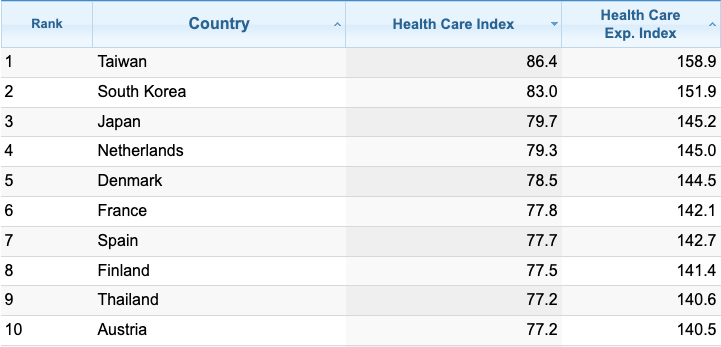
Source: NUMBEO
Opportunities of Taiwan’s Smart Healthcare Industry
1. Technological Expertise
Taiwan’s strength in semiconductor manufacturing and ICT (Information and Communications Technology) provides a solid foundation for developing innovative medical devices and health-tech solutions.
2. Aging Population
The rapidly aging population creates a growing demand for remote monitoring, elder care technologies, and personalized health solutions.
3. Global Market Expansion
Taiwanese companies can leverage the international demand for smart medical devices and software, targeting markets like Southeast Asia and beyond.
4. Government Support
Policies promoting innovation, funding for research and development (R&D), and startup incentives create a favorable industry growth environment.
5. Collaborative Ecosystems
Taiwan’s thriving ecosystem of universities, research institutions, and private enterprises fosters cross-sector collaboration in healthcare innovation.
Challenges of Taiwan’s Smart Healthcare Industry
1. Regulatory Hurdles
Complex regulatory requirements for medical device approval and data privacy laws can slow the deployment of innovative solutions.
2. Operational Models and Payment Systems:
Taiwan’s National Health Insurance (NHI) system, which accounts for over 95% of medical expenditures, does not yet have a clear payment structure for emerging products and innovative service models. This necessitates collaborative discussions among governmental agencies to develop suitable mechanisms.
3. Global Standards and System Integration:
Taiwan’s international medical data systems remain in the early stages. They must adopt globally recognized standards, such as the Fast Healthcare Interoperability Resources (FHIR), to advance research and development in digital healthcare and facilitate entry into global markets. Aligning with these standards is vital for accelerating digital health industrialization.
4. Cost Constraints
High initial investment costs and the need for continuous funding may deter smaller enterprises from entering the market.
Outsourcing Smart Healthcare and Medical Device Manufacturing in Taiwan
Taiwan is a good destination for outsourcing manufacturing of medical devices and smart health. The country’s strong industrial base, skilled workforce, and advanced manufacturing capabilities make it an attractive destination for medical device companies looking to outsource production.
Taiwan offers several advantages for outsourcing medical device manufacturing, including:
- Cost-Effective Manufacturing: Competitive labor costs and efficient production processes help reduce overall manufacturing costs.
- Skilled Workforce: A highly skilled and experienced workforce capable of handling complex manufacturing processes.
- Regulatory Compliance: Stringent adherence to international regulatory standards ensures the production of high-quality medical devices.
- Advanced Infrastructure: State-of-the-art manufacturing facilities equipped with the latest technologies for precision machining and quality control.
Taiwan’s smart healthcare industry holds immense potential, underpinned by its technological expertise and growing demand for digital health solutions. To unlock these opportunities, stakeholders must address regulatory challenges, foster talent development, and ensure the integration of fragmented healthcare systems. With the right strategies and collaborative efforts, Taiwan can solidify its position as a global leader in smart healthcare innovation.
Outsource your SCM work to us. We offer a balanced approach, combining affordability with quality. We help businesses connect potential suppliers, monitor supplier performance, manage risks, and ensure compliance with standards.
Subscribe to Yvette’s LinkedIn newsletter to read more other case studies in supply chain
CONTACT US FOR A CONSULTATION FOR UNIQUE SUPPLY CHAIN PROBLEMS OR SOLUTIONS
Read other related articles:
Medical Devices Outsourcing Market and Manufacturing/
References:
https://investtaiwan.nat.gov.tw/intelNewsPage202406060002eng?lang=eng&search=202406060002
https://www.itri.org.tw/english/ListStyle.aspx?DisplayStyle=01&SiteID=1&MmmID=1037333532373240766
