

Supply chain project management is the strategic application of planning, execution, and monitoring methodologies to complex supply chain initiatives. It involves coordinating specialized teams, physical resources, and global logistics to achieve specific goals, such as launching a new hardware product, transitioning to a new manufacturing facility, or implementing automated inventory systems. By utilizing structured frameworks, supply chain project managers systematically mitigate geopolitical risks, eliminate production bottlenecks, control operational budgets, and ensure that critical manufacturing milestones are successfully delivered on time and within scope.
Understanding Supply Chain Management vs. Project Management
Supply Chain Management and Project Management: The Symbiotic Relationship
Supply Chain Management (SCM)
It involves managing the flow of supplies through all stages of the production cycle including the sourcing, production, and distribution of products or services from raw materials to end customers. A series of interconnected processes span across different functions within an organization and often extend to external partners. The primary components of supply chain management include suppliers, manufacturing, production, distribution, inventory management, information systems, and customer service.
5 Main Supply Chain Processes:
- Plan: A strategy for the supply chain including forecasting demand, setting inventory policies, and establishing production and procurement plans. The goal is to align the supply chain with the overall business strategy.
- Source: Identifying and selecting suppliers, negotiating contracts, and establishing relationships with them. It also includes procurement of raw materials, components, and other inputs required for production.
- Make: The actual production or assembly of products takes place including manufacturing, scheduling, quality control, and production management. The goal is to efficiently produce goods while maintaining quality standards.
- Delivery: This process focuses on the logistics and distribution of finished products to customers: order management, warehousing, transportation, and delivery schedule. The aim is to ensure products reach customers in a timely and cost-effective manner.
- Return: Also known as the reverse logistics process, this deals with handling product returns, recycling, or disposing of defective or unwanted products. It includes return authorization, product recall processes, and recycling programs. Effective return processes are important for customer satisfaction and sustainability.
Project Management (PM)
Project management entails the application of processes, methods, skills, knowledge, and experience to develop and reach specific project objectives within agreed parameters, according to project acceptance criteria. The final deliverables of project management are constrained by a finite budget and timeframe. Key elements of project management include scope, schedule, quality, cost, risk, and procurement.
What is Supply Chain Project Management?
Supply chain project management refers to the process of planning, executing, and controlling projects within the context of a supply chain or logistics operation. It involves the application of project management principles and practices to ensure that specific supply chain-related projects are completed successfully, on time, within budget, and with the desired outcomes.
The next part will explain the relationship between SCM and PM to see how they relate to and leverage together

The Role of Project Management in Supply Chain Optimization
Identifying Project Management within Supply Chains
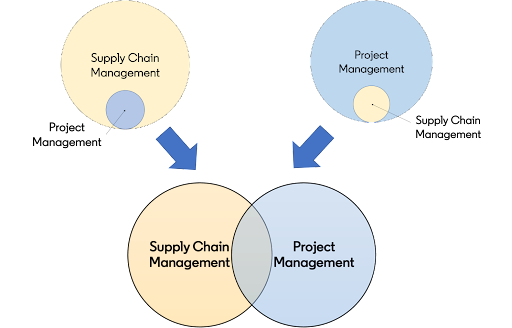
While supply chain management focuses on the ongoing flow of goods and services, project management plays a critical role in planning and driving improvements within this complex system.
Source: Bonnie’s Project Pointers
Effective project managers must have a deep understanding of the supply chain environment in which they operate. This means more than just grasping procurement processes and systems; it involves comprehending the holistic nature of supply chain management. This integration extends beyond procurement to encompass vital functions like operations management, manufacturing, logistics, and beyond.
Conversely, supply chain managers must also be well-versed in project management skills to successfully adapt to changes and implement supply planning improvements. Project management revolves around delivering value by developing or modifying products, systems, and processes. In today’s dynamic landscape, project managers have an array of tools at their disposal, including methodologies like Waterfall, Agile, and Lean Six Sigma.
A fascinating trend on the horizon is the rising demand for supply chain project managers. These professionals possess the unique blend of supply chain management expertise and project management skills required to lead initiatives aimed at enhancing supply chains. With the ever-accelerating pace of change driven by factors like technology, geopolitics, and global events such as the pandemic, the future looks exceptionally promising for supply chain project managers. Their ability to navigate these complex dynamics positions them as invaluable assets in the evolving business landscape.
What Do Supply Chain Project Managers Do?
A supply chain project manager oversees projects that deal with manufacturing operations and raw materials procurement. They are responsible for driving supply chain strategy, optimizing processes, and ensuring the seamless operation of supply chain activities. They must possess strong leadership, project management, and analytical skills to succeed in this multifaceted role and contribute to the overall success of the organization’s supply chain management efforts.
The Importance of Project Management Methodologies
Effective project management relies on established methodologies and best practices. Two widely adopted methodologies in supply chain optimization are Six Sigma and Lean. Six Sigma aims to reduce defects and variations in processes, while Lean focuses on eliminating waste and enhancing efficiency. Both methodologies provide structured approaches to tackle specific projects aimed at improving supply chain performance.
Streamlining Supply Chain Management with Project Management
Project Management in Procurement
Efficient procurement is a cornerstone of a well-functioning supply chain. Project management, led by a project manager, can be applied to procurement processes to identify cost-saving opportunities, streamline supplier relationships, and ensure timely delivery of raw materials, or components. This involves managing projects related to supplier selection, negotiation, and performance monitoring.
Enhancing Distribution and Logistics with Projects
Distribution and logistics involve the movement of goods from production facilities to distribution centers and ultimately to end customers. Project management tools and software are essential for optimizing these processes. Supply chain managers can lead projects aimed at route optimization, warehouse layout improvements, and transportation management system enhancements, all of which reduce transportation costs, minimize delivery times, and enhance overall supply chain visibility.
Inventory Management Projects
Inventory management is a critical area where project management can have a significant impact. Project managers can lead initiatives focused on implementing just-in-time (JIT) inventory systems, demand forecasting improvements, and ABC analysis. These projects are designed to reduce carrying costs, minimize stockouts, and improve inventory turnover rates, ultimately contributing to efficient supply chain management.
Challenges and Solutions in Integrating Project Management and Supply Chain Management
Overcoming Resistance to Change
Implementing project management practices within established supply chain processes may face resistance from supply chain managers and professionals accustomed to traditional approaches. Addressing this challenge requires effective change management strategies, including training, clear communication, and demonstrating the benefits of project management in managing projects.
Selecting the Right Project Management Tools and Software
Selecting the appropriate project management tools and project management software is crucial for supply chain project managers. These tools enable project managers to plan, execute, and monitor projects effectively. Careful consideration should be given to tools that align with supply chain management needs, ensuring efficient project management and risk management.
Ensuring Collaboration and Communication
Effective collaboration and communication are essential for successful integration. Cross-functional teams, led by supply chain project managers, should work together to ensure that projects align with supply chain goals and priorities. Regular status updates and reporting mechanisms are critical for transparency and accountability, reducing project risks and enhancing overall project management.

Case Studies: Successful Integration of Project Management and Supply Chain Management
Apple Inc.: Supply Chain Innovation through Project Management
Apple’s supply chain is renowned for its efficiency and innovation, largely due to the effective integration of project management practices. Supply chain project managers oversee projects that involve precise coordination among suppliers, manufacturers, and logistics partners, ensuring that products reach global markets seamlessly. This project-driven approach is instrumental in managing Apple’s complex supply chain and mitigating project risks.

Dell Inc.: Project-Driven Supply Chain Transformation
Dell’s supply chain transformation is a testament to the power of project management in managing projects and mitigating project risks. Dell revolutionized the computer industry by implementing a direct-to-consumer model and a build-to-order approach, all managed by supply chain project managers. Project management played a pivotal role in executing this transformation, allowing Dell to reduce inventory levels, cut costs, and improve customer satisfaction.

FAQ
Supply chain project management is the disciplined process of planning, executing, and controlling specific supply chain initiatives. It coordinates cross-functional teams, global suppliers, and logistical resources to achieve a defined objective, such as scaling manufacturing output, optimizing warehouse operations, or launching a physical product.
A supply chain project manager acts as the central hub connecting engineering, procurement, and manufacturing teams. They are responsible for defining project scopes, managing operational budgets, mitigating international shipping risks, and enforcing strict timelines to ensure physical products are manufactured and delivered seamlessly.
Supply chain management (SCM) is the continuous, ongoing daily operation of sourcing, producing, and delivering goods. In contrast, supply chain project management focuses on temporary, unique initiatives with a specific start and end date, such as building a new factory or implementing an ERP system.
Project management improves efficiency by providing structured workflows and clear accountability. It breaks down massive logistical initiatives into manageable phases, identifies critical path dependencies, eliminates redundant communication, and systematically removes manufacturing bottlenecks before they cause disastrous financial delays.
The lifecycle consists of five distinct phases: project initiation (defining the business case), thorough planning (setting budgets and timelines), active execution (procuring materials and manufacturing), rigorous monitoring and controlling (tracking quality KPIs), and formal project closure (final delivery and review).
Common methodologies include the Waterfall approach for highly structured, sequential manufacturing setups, and Agile methodologies for flexible, iterative product development. Many supply chain teams use a hybrid approach to maintain strict production milestones while remaining adaptable to sudden market changes.
The Critical Path is the longest sequence of dependent tasks that must be completed on time for the entire project to finish by its deadline. Identifying it allows project managers to strictly prioritize resources on the tasks that directly dictate the final delivery date.
Success is objectively measured using Key Performance Indicators (KPIs) such as Schedule Variance (was it completed on time?), Cost Variance (was it within budget?), defect rates, and Return on Investment (ROI). These metrics prove the financial value of the completed initiative.
Risk management is critical because global supply chains are highly vulnerable to geopolitical conflicts, extreme weather, and sudden material shortages. A robust project management plan proactively identifies these vulnerabilities and establishes strategic contingency plans, ensuring the project survives unexpected global disruptions.
Scope creep occurs when unauthorized changes or new requirements are continually added to a project without adjusting the budget or timeline. In hardware manufacturing, this leads to massive cost overruns, severe production delays, and completely derailed product launches.
A skilled project manager handles supplier delays by utilizing the Critical Path Method (CPM) to assess the exact impact on the final delivery date. They then execute contingency plans, such as expediting shipping freight, sourcing from backup vendors, or reallocating internal resources.
The biggest challenges include navigating complex international customs regulations, overcoming severe language barriers with overseas factories, managing multi-currency budget fluctuations, and maintaining strict quality control when production is outsourced thousands of miles away from the headquarters.
Cross-functional collaboration prevents operational silos. A successful supply chain project requires seamless, real-time communication between procurement, engineering, quality assurance, and logistics departments to ensure that design changes are instantly communicated to the factory floor, preventing expensive manufacturing errors.
Technology supports project management through advanced ERP systems, real-time logistics tracking software, and collaborative platforms like Gantt charts. These digital tools centralize data, automate procurement schedules, and provide managers with absolute visibility over global manufacturing and shipping operations.
A specialized third-party SCM partner provides vital localized expertise. They act as your “boots on the ground” in foreign manufacturing hubs, conducting direct factory audits, managing local supplier relationships, and troubleshooting assembly line issues instantly in the native language to keep your project on track.
SCM Solution – Your Supply Chain Partner in Asia!
The symbiotic relationship between supply chain management and project management offers businesses a unique opportunity to enhance efficiency, reduce costs, and gain a competitive edge. By identifying key areas where project management can optimize supply chain processes and address challenges through effective change management, businesses can create a dynamic, responsive, and agile supply chain that adapts to evolving market demands.
Let us help you manage supply chains from beginning to end. Our team with experience and knowledge in the industry supports and manages projects in the supply chain execution at all different stages to ensure the finished product meets the right quality standards and timelines and saves costs for your business projects. We also support and offer various supply chain services including operations management, quality control, product development process etc.
