

A Bill of Materials (BOM) is a comprehensive, structured inventory document that serves as the master recipe for manufacturing a product. It meticulously details every raw material, component, sub-assembly, and the exact quantities required to build a final shippable good. Beyond a simple parts list, a well-structured BOM functions as the central nervous system of supply chain management, directly guiding procurement, cost estimation, inventory tracking, and assembly line workflows. By standardizing engineering and manufacturing data, an accurate BOM prevents costly production delays, eliminates material shortages, and ensures strict quality control throughout the entire product lifecycle.
What is a Bill of Materials (BOMs)?
A Bill of Materials (BOMs) is a detailed and comprehensive list of components, sub-assemblies, and raw materials required to manufacture a product. It serves as a foundational document that guides the production process and inventory management. An accurate BOM ensures that the right materials are in the right place at the right time, which is crucial for efficient production planning and inventory management.
BOM Structure: Single vs. Multi-level Bill Of Materials
Before delving into the types of BOMs, it’s essential to understand the two primary BOM structures: Single-level BOM and Multi-level BOM
1. Multi-level BOM
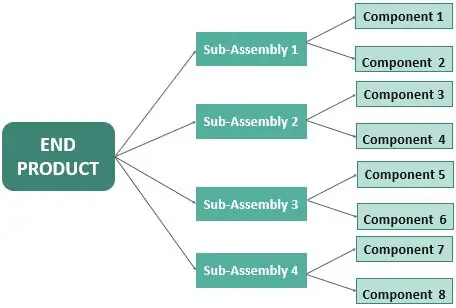
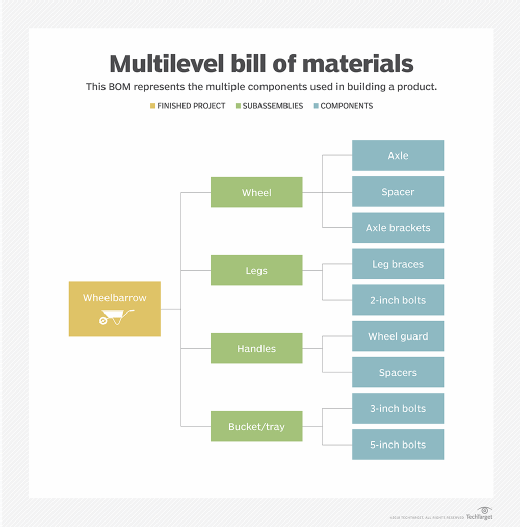
A multi-level BOM is a hierarchical structure that represents a product’s components at various levels of assembly. It offers a detailed view of how a product is assembled, showing its sub-assemblies, components, and raw materials. This structure is particularly valuable for complex products, including printed circuit board assemblies, where an in-depth understanding of the technical drawing and design phase is essential.
Source: Wall Street Mojo
Source: TechTarget
2. Single-level BOM
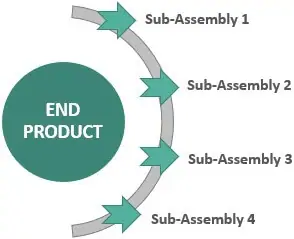
A single-level BOM provides a simplified view, listing only the immediate components required for the final assembly or inventory item. This single level bill of structure is useful for less complex products and inventory items where a basic structure is sufficient.
Source: Wall Street Mojo
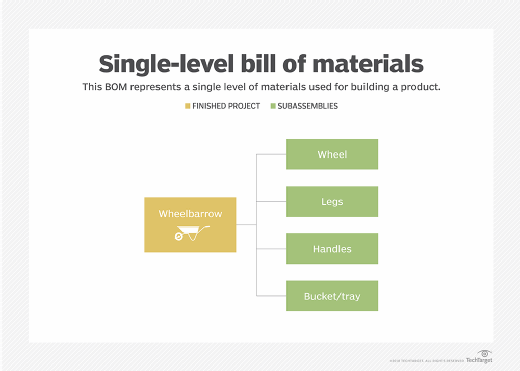
Source: TechTarget
Types of BOMs
BOMs come in various types, each serving a specific purpose in the manufacturing process. Let’s explore some of the most common types:
1. Manufacturing Bill of Materials (MBOM)
The manufacturing BOM contains detailed information about all the components and raw materials required for the actual production process. It’s a critical reference for the production line and helps in addressing materials shortages.
2. Engineering Bill of Materials (EBOM)
The engineering BOM is primarily used in the design and development stages. It lists the conceptual structure of a product and the relationships between components. In the design phase, it’s crucial to identify parts and create a technical drawing.
3. Configurable Bill Of Materials (CBOM)
Configurable BOM allows for product customization by specifying alternative components or options, catering to various customer preferences. This is essential for products with a modular BOM structure and interchangeable modules.
4. Sales Bill Of Materials (SBOM)
Sales BOM (SBOM) is designed for sales and marketing teams, providing a simplified view of the product structure to assist in customer communication and sales order document generation. It’s crucial for creating accurate sales order documents.
5. Production Bill Of Materials
Production BOM focuses on the components and materials required for the actual production process. It is material requirements planning helps in procurement type decisions and efficient materials management.
6. Assembly BOM
An assembly BOM provides a detailed breakdown of the components intermediate assemblies and sub-assemblies required for a specific assembly unit. It’s vital for creating an effective assembly component list.
7. Modular BOM
Modular BOMs are used for products with interchangeable modules, making it easy to maintain product structures and swap out components for different product variations. This is crucial for managing inventory items with materials templates.
Bill of Materials (BOM) Displays: BOM explosion vs. BOM implosion
A “BOM explosion” refers to expanding a BOM to view all its sub-components, providing a detailed understanding of the product’s structure. It means to explode the end product into its components or parts (end to start). This is particularly valuable for manufacturers as it provides a detailed view of the product’s structure, helping in planning, sourcing, and production. BOM explosion is often used when you need to understand the full list of components needed to manufacture a specific product.
Conversely, “BOM implosion” starts with a finished product and traces back through its subassemblies and components to determine what is required to build that final finished product (start to end). BOM implosion is useful for tasks like determining the total quantity of components needed for a certain number of finished products. This method is often employed in scenarios where you need to plan for production and ensure you have enough materials on hand to meet demand.
What are the key elements to create an effective BOM?
1. BOM Level
A bill of materials often contains several levels. A unique number showing where each part, finished product or assembly fits within the BOM hierarchy.
2. BOM notes
The notes are a place to document unexpected changes or other necessary information. Plus, taking notes during the project takes shape may include images, diagrams of a part or assembly process.
3. Quantity
The number of all the components needed will be used in an assembly or sub-assembly process.
4. Units of measure
Specifying what unit of measure a part helps ensure the right ordered quantities. For example, Per unit, inches, grams, kilograms, liters, square feet, cubic feet, etc., should be specified for each quantity. The purchase cost should be under the budget set for the project.
5. Part name
A record of a part name helps manufacturers identify parts and provides information about them.
6. Part number
The unique number identifies each part of components or materials. A part number can convey valuable information about a component, materials example, making it intelligent or significant. In contrast, an insignificant or non-intelligent part number is essentially a random identifier assigned to a part.
For instance, consider a screw with an intelligent part number like HSC0424OP. Here, ‘H’ indicates it’s a hardware part, ‘S’ denotes it’s a machine screw, ‘C0424’ represents its length, and ‘OP’ specifies the screw’s head style. On the other hand, an arbitrary numbering system might assign a part number like 000383487349 to the same screw, which lacks any additional meaning and solely serves to identify the part.
7. Part phrase
This shows where each part is in the product lifecycle. For example, a new part would be in the unreleased or in-design phase. Sometimes, a revision level is included in the part phase to indicate the part’s version.
8. Manufacturer name
Identifying the production places of components by listing the manufacturers’ name.
9. Procurement specification
The procurement specification describes how parts are purchased and made. The designations P, M and C are often used standing for purchased, modified and custom.
10. Description
Provide readers details of each part including color, dimensions, function, etc. It can attach with images or files
11. Alternate parts
In case the original part is unavailable, this tells the reader whether another one can be substituted.
Benefits of An Effective Bill Of Materials (BOMs)
- Improved supply chain management
- Streamlined manufacturing processes and product lifecycle management
- Enhanced product quality and consistency
- Efficient resource allocation
- Reduced production costs. Control budget well
- Stay on schedule
- Identify and stay alert to the cause of a production failure, materials shortages, expediting charges and planned and unplanned downtime
Challenges of creating BOMs
- Maintaining accuracy and consistency
- Handling changes and revisions, especially in ERP systems
- Ensuring effective communication among departments
- Navigating software and technology challenges, such as ERP systems.
How to Create BOMs in 7 Steps
- Define the product scope.
- Identify all components.
- Determine component quantities.
- Specify unit of measure.
- Document BOM notes and instructions.
- Review and validate the BOM.
- Implement a change control process, especially when using ERP systems.
Tips for creating an effective bill of materials bom
- Collaborate across departments, including the engineering department and contract manufacturers.
- Use BOM management software systems.
- Establish a clear change control process, especially in enterprise resource planning.
- Regularly update and review BOMs to maintain accurate materials displays and ensure production order accuracy.
NOTE: Determine who will be able to change the BOMs
Clearly define roles and responsibilities for BOMs modification to prevent unauthorized changes and maintain data integrity. This is very important in business operations.
BOM software systems
Consider using BOM management software systems to streamline the creation, maintenance, and sharing of BOMs. These tools can help in managing complex BOM structures and ensuring data accuracy, particularly for data center hardware.

Additional reading: History of the Bill of Materials (BOMs)
The Bill of Materials (BOM) is a vital part of the manufacturing process, and its history reflects the evolution of production processes:
- Early Manufacturing: BOMs originated in ancient civilizations, serving basic inventory control needs.
- Industrial Revolution: The Industrial Revolution, which began in the late 18th century, marked a significant turning point. With the advent of large-scale manufacturing, the need for more structured documentation of materials and components became apparent. Manufacturers began to develop rudimentary forms of BOMs to ensure efficient production.
- Standardization: The need for standardization and uniform product quality drove the development of more organized BOMs, particularly in industries like engineering and machinery.
- Computer Systems: In the mid-20th century, the advent of early computer systems and software applications revolutionized BOM management. These systems enabled companies to create digital BOMs, improving accuracy, speed, and the ability to handle complex product structures.
- MRP and ERP: In the 1970s and 1980s, the concept of Material Requirements Planning (MRP) and later, Enterprise Resource Planning (ERP) systems, significantly enhanced BOM management. These systems integrated BOMs with other business processes, such as inventory management, procurement, and production planning.
- BOM Software: The late 20th century and early 21st century witnessed a proliferation of specialized BOM software systems. These solutions allowed companies to manage Bill Of Materials more efficiently, collaborate across departments, and maintain version control.
- Globalization: Global supply chains made Bill Of Materials even more critical, requiring accurate management for production and inventory control.
- IoT and AI: Recent advancements in technology, like the Internet of Things (IoT) and Artificial Intelligence (AI), are further improving BOM management by providing real-time data for inventory and optimizing production.
Today, the history of Bill Of Materials reflects the constant evolution of manufacturing processes and technology. From early manual records to sophisticated digital systems, BOMs remain at the heart of efficient production, enabling companies to create high-quality products while managing costs and resources effectively.
FAQ
A BOM is a centralized, comprehensive list containing all the raw materials, components, assemblies, and exact quantities required to manufacture a finished product. It acts as the foundational blueprint connecting engineering, procurement, and factory assembly operations.
An Engineering Bill of Materials (EBOM) defines the product exactly as originally designed by the engineering team using CAD software. It focuses strictly on the functional and structural design components, often excluding packaging or manufacturing-specific consumables like custom tooling.
A Manufacturing Bill of Materials (MBOM) expands upon the EBOM by detailing all the parts and assemblies required to actually build the product on the factory floor. It includes packaging materials, assembly line consumables, and specific instructions for manufacturing routing.
The EBOM represents the product as designed by engineers, focusing solely on technical specifications. Conversely, the MBOM represents the product as it will be physically built in the factory, incorporating manufacturing processes, supply chain constraints, and the packaging required for final shipment.
A single-level BOM is a simple, flat list displaying the assemblies and components required for a product without showing hierarchical relationships. While exceptionally easy to read, it is only suitable for very basic products without complex sub-assemblies.
A multi-level BOM is a hierarchical structure that breaks down a complex product into detailed parent-child relationships, sub-assemblies, and raw materials. It shows the exact relational dependency between components, making it essential for complex manufacturing like electronics or automotive assembly.
A Configurable Bill of Materials (CBOM) is utilized for products offering multiple customizable variations, such as computers or vehicles. It allows manufacturers to dynamically generate a specific, unique BOM based entirely on the exact features and upgrades selected by the customer.
A professional BOM must include a standardized part number, precise part name, detailed description, exact quantity, unit of measure (UOM), procurement type (off-the-shelf vs. custom-made), and specific reference designators to guide automated factory assembly lines.
BOM accuracy is strictly critical because a single missing component or incorrect quantity can instantly halt the entire production line. An inaccurate BOM directly leads to severe material shortages, delayed product launches, inflated procurement costs, and massive factory rework.
Procurement teams use the BOM to execute a rigorous “Should-Cost” analysis. By mathematically multiplying the exact quantity of every listed material by its unit price, and adding expected labor overhead, they calculate the absolute baseline Cost of Goods Sold (COGS).
An Approved Vendor List (AVL) specifies the exact, pre-vetted suppliers authorized to provide each specific component listed on the BOM. Integrating the AVL directly into the BOM prevents purchasing teams from accidentally buying substandard or counterfeit parts from unverified brokers.
The initial EBOM is typically created by R&D and mechanical engineers. However, the final MBOM is a highly collaborative effort involving procurement specialists, manufacturing engineers, and supply chain managers to ensure the product is actually buildable and financially viable.
If a factory supplier substitutes a raw material without officially updating the approved BOM, it is considered unauthorized compliance fraud. This practice can lead to catastrophic product failures, voided safety certifications, and severe legal liabilities for the purchasing brand.
Enterprise Resource Planning (ERP) software centralizes BOM data, ensuring all departments work from a single digital source of truth. It automates inventory tracking, flags material shortages instantly, and manages strict version control whenever an engineering change occurs.
BOM revisions are strictly managed through a formal Engineering Change Order (ECO) process. Every modification to a part, supplier, or quantity is digitally logged with a new version number, ensuring the factory never accidentally builds a product using outdated specifications.
Hardware startups often struggle because they manage early BOMs on static Excel spreadsheets, leading to severe version control issues. When multiple engineers update different offline files simultaneously, the factory inevitably receives outdated component data, causing incredibly costly production errors.
In Printed Circuit Board Assembly (PCBA), reference designators (such as R1 for a specific resistor or C2 for a capacitor) are critical codes. They instruct the factory’s automated SMT pick-and-place machines exactly where each tiny component belongs on the bare board.
BOM scrubbing is a vital auditing process where supply chain experts review the document to identify obsolete parts, correct formatting errors, verify supplier global stock levels, and ensure environmental compliance (like RoHS) before officially sending the BOM to the factory.
BOM flattening takes a complex, multi-level BOM and collapses it into a single, consolidated list of raw materials. This allows procurement teams to easily calculate total aggregate component volumes for bulk purchasing negotiations, significantly reducing the Total Cost of Ownership.
A Sales BOM defines a product exactly as it is ordered and received by the end customer. Instead of detailing raw manufacturing materials, it lists the finished item alongside packaged accessories, printed manuals, and warranty cards that make up the final shippable SKU.
A hardware BOM lists the physical materials and electronic components required for manufacturing. Conversely, a Software Bill of Materials (SBOM) is a crucial cybersecurity inventory detailing all open-source software components, code libraries, and dependencies embedded within a digital product to proactively track and patch security vulnerabilities.
A Costed Bill of Materials assigns a specific financial value to every single component, labor hour, and tooling requirement listed in the manufacturing recipe. It provides supply chain managers with a highly accurate Total Cost of Goods Sold (COGS), enabling them to calculate final retail pricing and profit margins.
During severe shortages, procurement teams manage BOMs by proactively identifying “Form, Fit, and Function” (FFF) alternate cross-reference parts. By officially adding these pre-approved substitute components directly to the BOM’s Approved Vendor List (AVL), factories can instantly pivot production if the primary supplier fails to deliver.
A Green BOM integrates environmental compliance data directly into the product’s engineering structure. It tracks raw material carbon footprints, ensures strict legal compliance with RoHS and REACH hazardous substance regulations, and verifies that all listed components are ethically sourced and safely recyclable at the end of their lifecycle.
Artificial Intelligence improves BOM management by autonomously predicting component obsolescence and identifying hidden geopolitical risks across the Approved Vendor List (AVL). AI also automates the tedious BOM scrubbing process, instantly catching formatting errors, pricing anomalies, and suggesting cost-effective alternate parts in real-time before manufacturing begins.
Summary
In conclusion, a well-structured manufacturing Bill of of Materials (BOMs) is a cornerstone of efficient manufacturing processes, and understanding its various aspects is crucial for businesses aiming to excel in the world of production and assembly. Whether you are in design, production, or sales, BOMs play an indispensable role in ensuring your products are made to perfection, and inventory management remains accurate.
