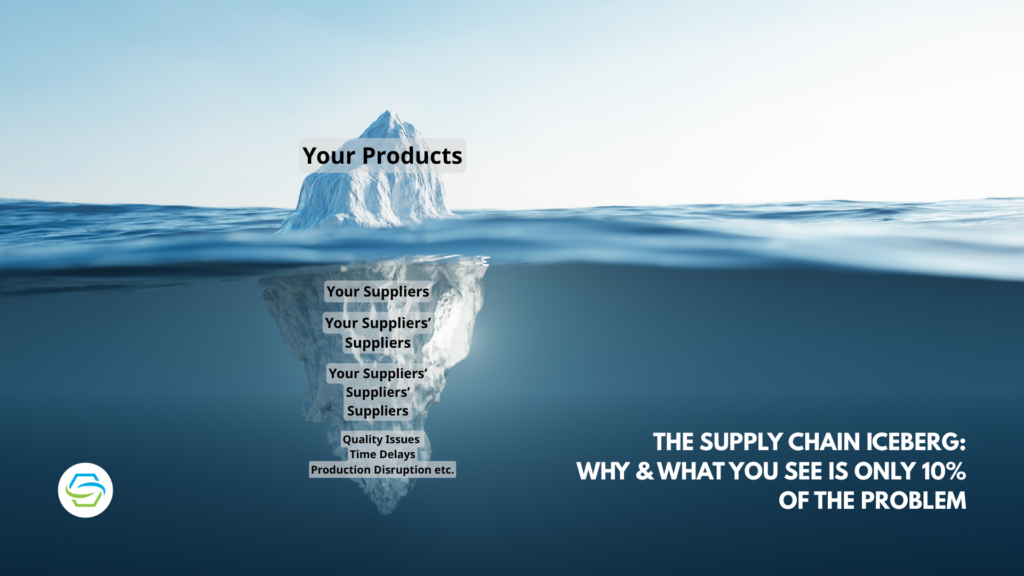
The supply chain iceberg is a strategic business framework illustrating that visible operational factors, such as unit purchase prices and freight costs, represent only 10% to 20% of total supply chain expenses. The remaining 80% to 90% consists of hidden risks and structural complexities submerged below the surface. These hidden factors include unpredictable demand fluctuations, multi-tier supplier vulnerabilities, inventory holding costs, regulatory compliance issues, and quality defects. Effectively managing this entire iceberg is critical for modern businesses and hardware startups to proactively mitigate global disruptions, ensure product launch timelines, and protect long-term corporate profitability.
In today’s globalized economy, many companies believe their supply chains are under control, orders are shipped on time, inventory levels look healthy, and transportation costs are tracked carefully. Yet disruptions still happen. Deliveries are delayed, costs suddenly spike, quality issues appear, or suppliers fail without warning.
Why?
Because supply chains behave like icebergs.
What you see above the surface: daily operations and performance metrics, represents only a small fraction of the full system. The majority of risks, inefficiencies, and cost drivers lie beneath the surface, hidden from immediate view but critical to long-term performance.
Understanding the Supply Chain Iceberg is crucial for developing resilient, cost-effective, and sustainable supply chains.
What Is the Supply Chain Iceberg?
The Supply Chain Iceberg is a framework that explains how visible operations account for only about 10–20% of total supply chain complexity. The remaining 80–90% consists of hidden risks, structural inefficiencies, and systemic dependencies that often go unmanaged until something breaks. Companies that focus only on surface-level indicators are often reactive. Those who manage the full iceberg gain a strategic advantage.
The Visible Part of the Iceberg (Above the Water)
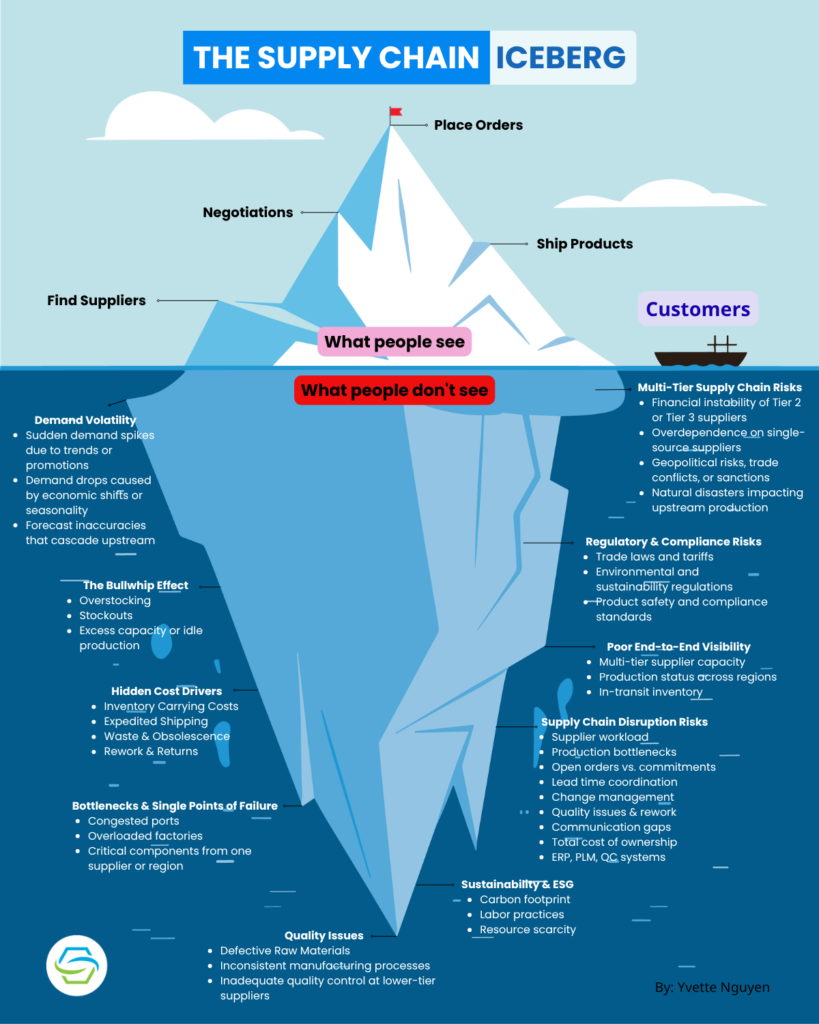
From a customer’s perspective, the supply chain often looks simple: find suppliers → negotiate → place orders → ship products.
These are the activities most companies focus on because they are visible, easy to measure, and directly connected to customer experience. They represent the part of the supply chain that organizations actively manage daily.
This visible layer includes:
- Order Fulfillment: Processing customer orders, managing deliveries, and handling returns.
- Inventory Management: Tracking stock levels across warehouses, distribution centers, and retail locations.
- Transportation & Logistics: Coordinating freight movements, shipping schedules, and last-mile delivery.
- Supplier Relationships: Maintaining direct communication and coordination with Tier-1 suppliers.
These operations are critical, but they provide an incomplete picture. They tell you what is happening, not why it’s happening or what risks are building underneath.
The Hidden Part of the Iceberg (Below the Water)
What really breaks supply chains is rarely what you can see.
Most companies only have visibility into their direct suppliers. Everything beyond that Tier-2 and Tier-3 suppliers often remain invisible. When one of those upstream partners faces financial trouble, geopolitical restrictions, or a natural disaster, production can stop overnight, even if your Tier-1 supplier looks perfectly fine.
At the same time, demand is never stable. A small spike caused by a promotion or a sudden drop from an economic shift can quickly ripple upstream. What starts as a minor forecast error often turns into shortages, excess inventory, or delayed production across multiple suppliers.
Regulations add another hidden layer of risk. Trade policies, environmental rules, and product safety requirements change faster than many supply chains can react. When compliance is overlooked, the consequences show up later as shipment delays, unexpected costs, or forced supplier changes.
Operational Inefficiencies Beneath the Surface
Small problems become big ones when they travel upstream.
Minor demand changes can trigger the bullwhip effect, creating overstock in one place and shortages in another. Without clear coordination, suppliers ramp up or slow down at the wrong time, quietly wasting capacity and money.
Limited end-to-end visibility makes this worse. Many companies don’t know their suppliers’ real capacity, production status, or where inventory is once it’s in transit. Decisions are made late, under pressure, and often at a higher cost.
Bottlenecks like congested ports, overloaded factories, or reliance on a single critical component usually stay hidden until they stop everything. By the time they’re visible, options are already limited.
Quality issues follow the same pattern. Defects rarely start where they’re discovered. Problems in raw materials or early production stages often surface only at the end, when fixing them is slow, expensive, and disruptive.
Hidden Costs That Quietly Drain Margins
Even when unit prices look competitive, hidden costs pile up.
Excess inventory ties up cash and warehouse space. Delays force companies into costly expedited shipping. Unsold or outdated products turn into waste. Quality problems lead to rework, returns, and lost trust.
Individually, these costs seem manageable. Together, they slowly erode margins and distort the true cost of the supply chain.
Sustainability & Ethical Risks Below the Iceberg
Sustainability risks rarely sit at the surface.
Most emissions come from suppliers and logistics partners, not from your own facilities. Labor issues often occur deeper in the supply chain, far from direct oversight. Dependence on scarce materials like semiconductors or lithium creates long-term supply vulnerability.
When these risks are ignored, they don’t just affect operations; they damage reputation, invite regulatory scrutiny, and threaten long-term stability.
Why Managing the Full Iceberg Matters, Especially Startup in Product Development Progress?
For startups, product development is often a race against time, budget, and uncertainty. Teams focus heavily on what’s visible: prototypes, tooling, unit costs, lead times, and shipping schedules. While these elements are important, they represent only a small portion of the real supply chain picture.
Managing only the visible layer of the supply chain exposes startups to hidden risks that can derail product development entirely. Issues such as Tier-2 and Tier-3 supplier failures, material shortages, quality problems, regulatory changes, and logistics bottlenecks often remain unnoticed until they cause delays, cost overruns, or even project cancellation.
Unlike large corporations, startups typically lack financial buffers, alternative suppliers, or excess inventory. A single disruption, such as a component shortage or unexpected tooling delay, can push back a product launch by months and strain cash flow.
By managing the full supply chain iceberg early in the product development process, startups can:
- Identify hidden risks before committing to tooling and mass production
- Build realistic timelines and budgets
- Reduce rework, expedited shipping, and last-minute changes
- Make better sourcing and design decisions
- Increase the likelihood of a successful product launch
For startups, supply chain resilience isn’t a “nice to have.” It’s a survival strategy.
How to Manage the Entire Supply Chain Iceberg
To move beyond surface-level management, companies should:
- Map multi-tier suppliers, not just Tier 1
- Improve end-to-end visibility with data and real-time tracking
- Adopt risk-based planning, not forecast-only planning
- Integrate quality, logistics, and procurement data
- Embed sustainability and ESG into supplier selection
- Regularly stress-test the supply chain for disruption scenarios
FAQ
The supply chain iceberg is a conceptual framework demonstrating that visible daily operations like order placement and shipping account for only a small fraction of total supply chain complexity. The vast majority of costs, systemic risks, and operational inefficiencies remain hidden “below the surface” until a disruption occurs.
The visible part of the iceberg, sitting above the water, represents easily measurable, day-to-day operations. This includes direct Tier-1 supplier communication, base unit purchase prices, inventory tracking in primary warehouses, standard freight transportation schedules, and the final delivery of goods to the end customer.
The hidden part of the iceberg consists of unmanaged, systemic risks. These include vulnerabilities in invisible Tier-2 and Tier-3 suppliers, the bullwhip effect from volatile demand, hidden inventory holding costs, expedited shipping penalties, environmental compliance risks, and late-stage quality control defects.
Hidden costs slowly erode profit margins because they are rarely budgeted for upfront. These include the cost of capital tied up in excess safety stock, emergency expedited air freight due to delayed production, factory rework caused by poor quality control, and wasted warehouse space for obsolete inventory.
Focusing solely on Tier-1 suppliers creates a false sense of security. If an invisible Tier-2 or Tier-3 supplier providing critical raw materials experiences a natural disaster, financial bankruptcy, or geopolitical sanction, the entire production line stops, even if the direct Tier-1 partner is operating perfectly.
Quality issues are a massive hidden risk because minor defects in raw materials or early assembly stages are often not discovered until final inspection or after market release. Fixing these late-stage defects requires expensive factory rework, product recalls, and irreparably damages consumer trust.
The bullwhip effect occurs when small, temporary shifts in consumer demand cause massive, disproportionate fluctuations upstream in the supply chain. This lack of clear end-to-end communication forces factories to either overproduce (creating excess inventory) or underproduce (causing stock outs and lost sales).
Startups are particularly vulnerable to the supply chain iceberg because they operate with limited financial buffers and strict launch timelines. A single hidden disruption—such as an unexpected tooling delay, component shortage, or failed regulatory certification—can entirely derail a new product launch and drain critical cash flow.
Startups can avoid hidden costs by actively mapping their multi-tier supply networks early, integrating Design for Manufacturing (DFM) principles to reduce complex assembly steps, validating components through strict EVT/DVT/PVT phases, and securing backup suppliers before committing to mass production.
Environmental, Social, and Governance (ESG) risks lurk deep within the supply chain iceberg. Reliance on suppliers with unethical labor practices or heavy carbon emissions can trigger sudden regulatory fines, border confiscations, and severe brand boycotts from environmentally conscious consumers and investors.
Companies improve visibility by adopting digital supply chain mapping tools, integrating real-time ERP software with their suppliers, and demanding transparency into Tier-2 and Tier-3 vendor operations. This data-driven approach illuminates the hidden portion of the iceberg, allowing for proactive, predictive management.
Risk-based planning moves away from relying purely on historical sales forecasts. Instead, it involves actively mapping potential disruption scenarios (e.g., port strikes, raw material shortages) and building strategic contingency plans, safety stock buffers, and alternative sourcing routes to ensure continuous operations.
Managing the full iceberg requires cross-functional integration because siloed departments create blind spots. When procurement, engineering, quality control, and logistics share real-time data, the company can identify how a minor design change might inadvertently cause a massive shipping delay or a hidden manufacturing cost.
Companies should stress-test their supply chain networks at least annually, or immediately following a major geopolitical shift or market disruption. These simulated tests help executives identify structural weaknesses in vendor capacity, logistics routes, and cash flow resilience before an actual crisis hits.
Partnering with a specialized Third-Party (3PL) or Fourth-Party Logistics (4PL) provider like SCM Solution gives brands immediate access to advanced tracking technology, established global vendor networks, and dedicated compliance experts. This effectively transfers the burden of navigating the hidden iceberg to experienced industry professionals.
Calculating hidden disruption costs requires looking far beyond simple freight penalties. It involves strictly quantifying lost sales revenue due to stock outs, the extreme financial impact of halted factory production lines, the premium cost of emergency expedited sourcing, and the long-term devaluation of brand reputation.
Just-In-Time (JIT) minimizes inventory holding costs by receiving goods exactly when needed, maximizing capital efficiency but increasing vulnerability to disruptions. Just-In-Case (JIC) intentionally maintains higher safety stock buffers to prevent critical stockouts during unexpected global crises, sacrificing some lean efficiency for massive operational resilience.
Hardware startups build early resilience by actively dual-sourcing critical electronic components, utilizing standardized off-the-shelf parts whenever possible, partnering with experienced Contract Manufacturers (CMs), and enforcing strict Design for Manufacturing (DFM) guidelines to ensure rapid production flexibility if their primary factory encounters unexpected downtime.
End-to-end visibility is achieved by digitizing the supply chain using cloud-based ERP systems, IoT tracking sensors, and AI-driven supplier portals. This advanced tech stack allows companies to map Tier-1 through Tier-3 vendors, track real-time inventory movements, and proactively identify hidden bottlenecks before they cause disruptions.
Artificial Intelligence analyzes massive global datasets to predict potential supply chain disruptions, such as geopolitical shifts, severe weather events, or sudden demand spikes. AI algorithms optimize safety stock levels, automate supplier risk scoring, and dynamically recommend alternative shipping routes to navigate the hidden iceberg.
Final Thoughts
The Supply Chain Iceberg reminds us that smooth daily operations do not guarantee stability. The real threats and opportunities lie beneath the surface.
Organizations or those who work in Supply Chain that invest in understanding and managing hidden risks, inefficiencies, and dependencies don’t just survive disruptions; they emerge stronger.
Because in supply chain management, what you don’t see can hurt you the most.
If you’re a startup or growing brand struggling with sourcing, communication gaps, or quality issues, we can help. SCM Solution specializes in helping companies build reliable, transparent supply chains in Taiwan and Southeast Asia.
📩 Contact us to discuss and start your fashion product development!
Additional Resources
- Case Studies: How SCM Solution Helped Businesses Succeed
- Quality Inspection Service: What You Need To Know
- Choosing the Right SCM Services for Your Business
Follow our LinkedIn page to get further activities
Subscribe to Yvette’s LinkedIn newsletter to read more other case studies in supply chain
