

The Chinese New Year (CNY) and Lunar New Year (LNY) supply chain in 2025 is coming. This period will significantly impact global supply chains, particularly affecting industries reliant on Asian manufacturing. Given the annual surge in shipping volumes before the holiday and the subsequent production slowdown, preparing for CNY in 2025 will be essential.
When are CNY and LNY 2025?
Here are the schedules for public holidays. We separated into 2 different calendars for different cultures of Asian countries. Even though this article’s title mainly focuses on CNY, we still give both timelines for reference.
Chinese New Year (CNY) is celebrated in China, where it is a public holiday and one of the biggest celebrations of the year.

Lunar New Year (LNY) is celebrated on different dates by various Asian countries including Vietnam, Taiwan, Malaysia, Indonesia, Brunei, Singapore, South Korea, and across parts of Southeast Asia.
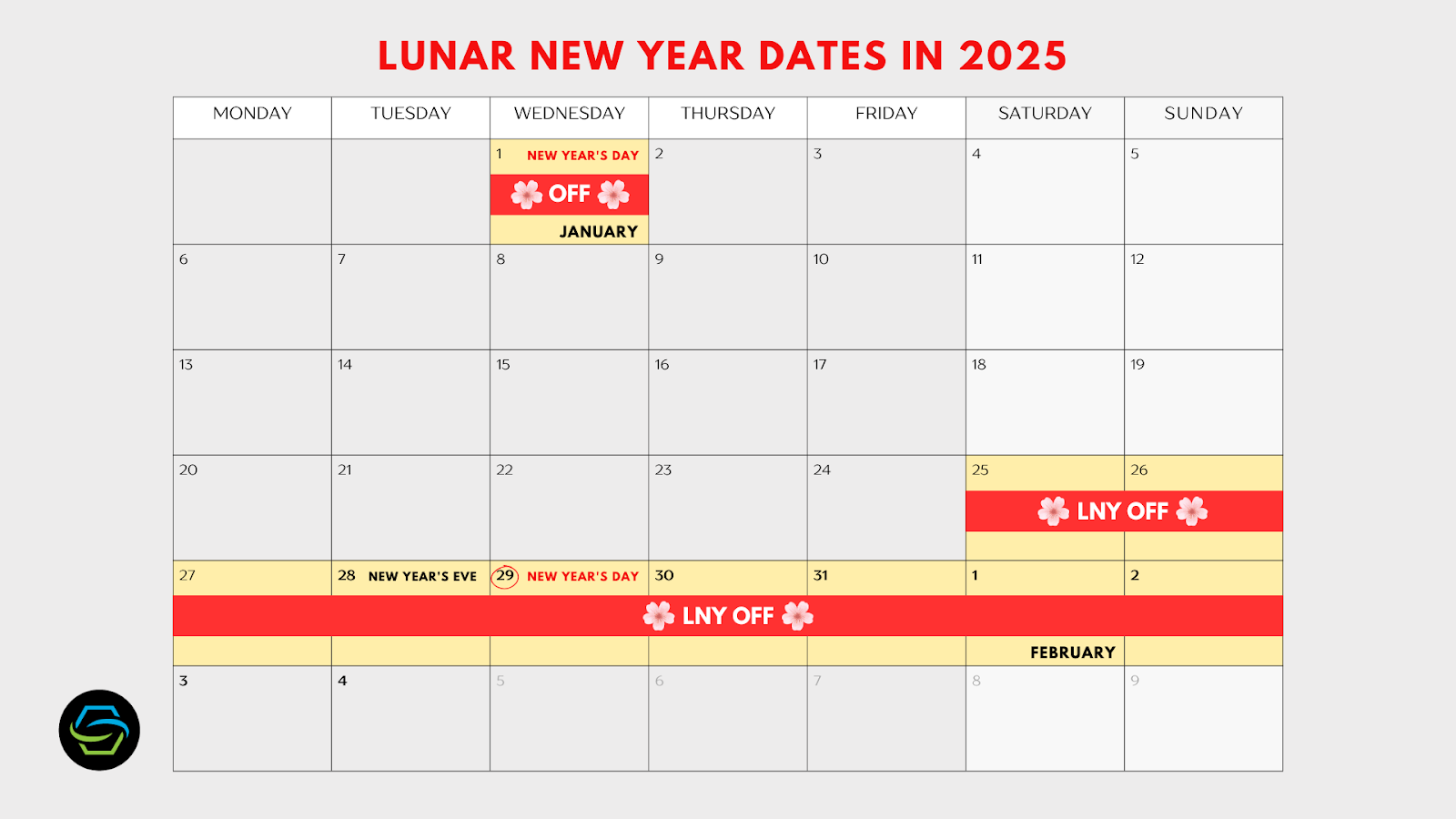
Supply Chain Schedule for CNY 2025

Impact Timeline in Supply Chain Schedule:
- Pre-CNY Rush: Factories increase production in December and January to fulfill orders, leading to port congestion and longer lead times.
- Shutdown Period: Most factories close for 1-2 weeks, with some smaller suppliers extending closures. Logistics services may also scale down.
- Post-CNY Recovery: Many workers delay returning to factories, causing labor shortages and a slow ramp-up in production.
What happens to Supply Chain Logistics, especially when President-elect Donald Trump Starts His Administration in 2025?
President-elect Donald Trump will start his second term on January 20, 2025. Supply chain logistics between the U.S. and China could experience unique complexities influenced by U.S.-China relations, trade policies, and any new tariffs or restrictions.
1. Potential for Increased Tariffs or Trade Restrictions
Trump may implement additional tariffs or restrictions on Chinese imports, affecting the costs and flow of goods around the CNY period when demand is already high. Businesses may need to factor in potential tariff-related costs and seek alternative sourcing to avoid disruptions. Stricter trade policies might further complicate logistics, as companies may need to adjust supply chain strategies to navigate increased compliance requirements.
2. Focus on “Reshoring” and Supply Chain Diversification
Trump’s previous focus on bringing manufacturing back to the U.S. or encouraging trade within North America could drive companies to diversify their supply chains away from China, especially around CNY when production slows down. This could result in a broader shift in sourcing and manufacturing locations, with more emphasis on countries like Vietnam, or Taiwan to offset dependency on Chinese suppliers.
3. Customs and Regulatory Changes
New trade policies could lead to more stringent customs checks and delays for goods from China, especially during high-demand periods like CNY. Additional inspections or document requirements might slow the movement of goods, increasing the risk of bottlenecks. Companies may need to prepare for longer customs clearance times and stay informed on any new documentation or tariffs introduced for Chinese imports.
4. Higher Freight Rates and Transportation Costs
Tariff uncertainty could drive freight rates higher as businesses rush to import goods before any additional tariffs or restrictions take effect. During the pre-CNY rush, this could further amplify freight rates, impacting shipping budgets.
Alternative transport methods, like air freight, may be considered to avoid delays, but this will likely be more costly, especially with increased CNY demand.
5. Labor and Logistical Challenges Post-CNY
With labor returning more slowly after CNY and any new tariffs impacting import schedules, businesses might experience longer lead times and higher transport costs due to demand spikes.
The focus on resilience in Trump’s potential administration could drive more companies to adopt digital tools and diversified sourcing to reduce reliance on Chinese manufacturing, particularly around peak times like CNY.
Read another related article Trump Tariffs: A Look Back and Next Plan in 2025
Strategies Approach to Navigating Challenges of Supply Chain in CNY 2025
1. Forecasting Demand and Inventory Management
Order Early: Place orders by late Q3 or early Q4 2024 to ensure production before CNY closures.
Stockpile Inventory: Build up safety stock to cover demand during and after CNY disruptions.
2. Freight and Logistics Preparation
Book Early: Reserve shipping slots in advance to avoid higher costs and limited capacity during the pre-CNY rush.
Diversify Shipping Modes:
- Despite higher costs, consider air freight for time-sensitive shipments to bypass port congestion.
- Collaborate with freight forwarders to identify alternative routes or carriers.
Monitor Port Activity: Use real-time tracking tools to stay updated on port conditions and adjust shipping plans accordingly.
3. Communication and Collaboration
Supplier Coordination:
- Confirm factory holiday schedules and production timelines well in advance.
- Maintain open communication with suppliers to ensure transparency on order progress and delivery schedules.
Customer Updates:
- Proactively inform customers of potential delays and adjusted timelines.
- Offer alternative products or solutions to manage customer expectations.
4. Contingency Planning for Geopolitical Influences
If Policy Shifts Occur: A new U.S. administration of Donald Trump in 2025, may increase tariffs or justify trade restrictions, complicating logistics with China during CNY. Stay informed about policy changes and work with customs brokers to navigate new regulations.
Build Resilience: Collaborate with third-party logistics providers (3PLs) for flexible transport solutions. Explore suppliers outside China to reduce dependence on a single region during high-risk periods like CNY.
FAQs – Summary
1. When will factories be in LNY/ CNY 2025?
- LNY 2025 will be from January 25 to February 2.
- CNY 2025 will be from January 28 to February 4.
2. How long do factories in China and other Asian countries shut down?
1-2 weeks. (*) Note: Confirm factory holiday schedules and production timelines well in advance.
3. How does LNY/ CNY 2025 affect businesses?
- Shortages of goods
- Higher prices
- Limited operational capacity
- Port congestion
4. What happens to Supply Chain Logistics, especially when President-elect Donald Trump Starts His Administration in 2025?
President-elect Donald Trump will start his second term on January 20, 2025.
- Potential for increased tariffs or trade restrictions
- Customs and regulatory changes
- Higher freight rates and transportation costs
Conclusion
The Chinese New Year (CNY) / Lunar New Year (LNY) is a meaningful time of celebration, family reunions, and new beginnings in Asian countries. These insights can offer readers practical strategies for mitigating risks and sustaining operations during the high-impact period in 2025.
Let SCM Solution Help You Manage Your Supply Chain in Asia
At SCM Solution, we specialize in helping businesses confidently navigate supply chain complexities. Our cutting-edge tools provide real-time visibility, predictive insights, and seamless coordination, ensuring that your supply chain remains resilient, even during high-impact events like CNY/ LNY. Partnering with us to keep your operations running smoothly and stay ahead of the competition.
Do You Have Any Supply Chain Issues for the upcoming CNY 2025? Let’s Share to Us
Subscribe to Yvette’s LinkedIn newsletter to read more other case studies in supply chain
